
History, Applied
Every subject Brad has worked on, an editor, a newspaper, a profession, a development site, has raised the same questions: what actually happened, who carries its memory, and on what evidence.
It began with his PhD at Deakin University, a critical reappraisal of The Age editor Graham Perkin, now becoming a full-length biography. The legend remembers a crusading, progressive editor. The record shows more: an editor who helped open The Age to women while taking part in its larrikin, sexist newsroom culture; a public progressive who was privately conservative; a celebrated career that owed much to a wife who never had the chance to build her own.
Places acquire legends too. A factory, a suburb, a street corner each come with a version of their past that has been told and retold, and the record usually complicates it: who was there, who was left out, what was decided and at what cost. Going back to that record is the same work whether the subject is a person or a place.
The books are where that work is explicated in full depth. The Evidence to Story Framework is how it reaches the places being built now.
How the Evidence to Story Framework works →The books
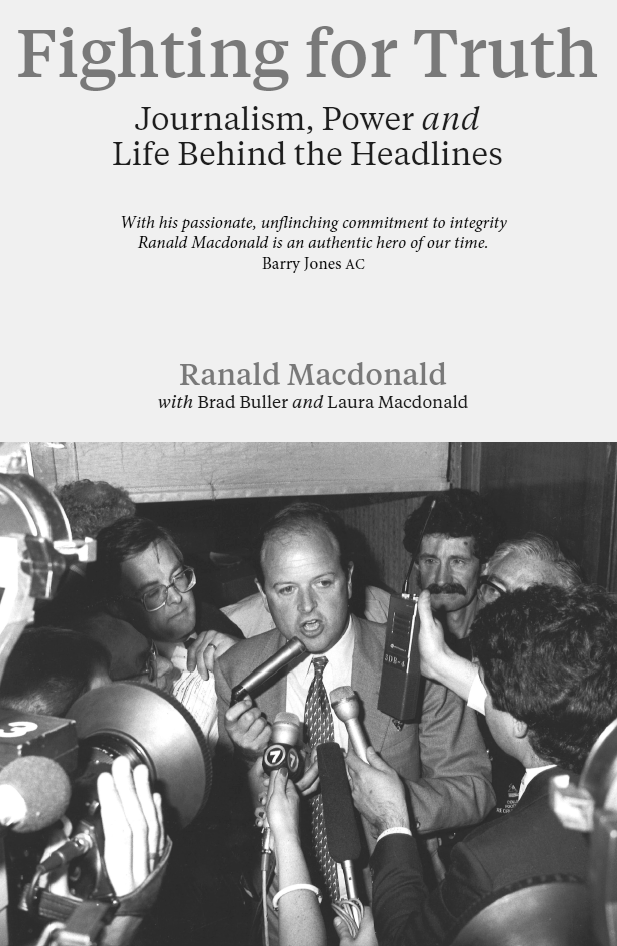
Fighting for Truth: Journalism, Power and Life Behind the Headlines
'With his passionate, unflinching commitment to integrity Ranald Macdonald is an authentic hero of our time.'
—Barry Jones AC
Coming March 2027Hardie Grant Books
A story of ambition, upheaval and an unrelenting struggle for media freedom. Fighting for Truth charts Ranald Macdonald’s transformation of The Age, his battles with powerful media interests, the turbulence of Collingwood Football Club’s “New Magpies” era, and the personal cost of his later ventures beyond journalism. At its core, it is a firsthand account of a media landscape in flux, and one publisher’s determination to keep journalism honest.
Brad's role
Across extended interviews, Brad helped Ranald draw out and order a lifetime of memories, tested them against newspaper archives and the documentary record, and shaped the material into a sustained narrative. Alongside research and writing, Brad brought the same rigour that underpinned his PhD work on Graham Perkin, and the collegiality that comes from close collaboration, to a project that holds the setbacks alongside the achievements.
Upheaval
Disrupted lives in journalism
When Fairfax Media announced in June 2012 that 1900 staff would be made redundant, a group of Australian academics quickly recognised that these redundancies marked a historical turning point — the end of a golden age in journalism — that needed to be studied and recorded. Upheaval, edited by Andrew Dodd and Matthew Ricketson, attempts to tell the stories of those discarded by their employers often in the prime of their careers, and through their eyes tell a bigger story of what journalism was like in its heyday and how it has changed.
Brad's contributions
'The constant undercurrent: Sexual harassment and discrimination'
(with Penny O'Donnell & Merryn Sherwood)
Chapter 6, pages 89-101
'Pickets and payouts: Unions in the newsroom'
(with Penny O'Donnell & Matthew Ricketson)
Chapter 13, pages 199-214
copy here
Praise for Upheaval
'I doubt there is anyone who has worked — or currently works — in journalism that would not have tears rolling down their cheeks as they read the stories of redundancy within Australia’s faltering news industry in this carefully edited collection. That’s not to say that Upheaval: Disrupted Lives in Journalism doesn’t also provoke laugh-out-loud moments at memories of newsroom antics or angry agreement about bullying, misogyny and blatant gender discrimination, but there is no getting around the fact that the central point of this book is tell the stories of the human impact of the brutal gutting of Australia’s media.'
— Pacific Journalism Review
'While the easier option would have been to tell the story through fewer narrators, the authors of this volume have given a masterclass in how to use oral history in a long form narrative. The result may read as though it were effortless, but I can attest that such an approach is not. Three longer profiles (Marr, Meade and Flip Prior) provide a deeper insight into the effect of the digital upheaval on individuals, and I suspect other interviews would have been equally as rich.'
— Australian Policy and History
'The early chapters lovingly describe the golden days of journalism at the peak of its influence. We are plunged into frenzied newsrooms with larger-than-life characters … At times, the stories read like the types of yarns, tinged in black humour, that journos would swap in the pub after deadline. But the authors do not shirk from the downsides of that newsroom culture as well: the lack of work-life balance, bullying and sexual harassment, and alcohol abuse.'
— Medium
This is undoubtedly a powerfully nostalgic book. But it also raises timely questions about the value that we attach to public interest journalism and whether we can find ways to sustain what is valuable in it.
— ArtsHub
'Essential reading for those who care about journalism and its struggle to survive. This book captures the essence of what it is to be a reporter amid tectonic shifts in the media and in the world that we strive to make sense of for our audiences. Anyone who follows the news and politics will be absorbed by Upheaval.'
— Nick McKenzie
The same method, applied to place
Consultancy
The consultancy brings the historian’s method to the places being built now. Through the Evidence to Story Framework, Brad Buller, PhD works with development and design teams from acquisition through design, marketing and community engagement, establishing what a site has been and what it still carries, to make that intelligence useful.
“Any precinct can build a food hall, a gym and a childcare centre. None can build the history of its own site; it can only find and embed it.”
Read the full essay