
What survives when there’s no wall left standing
Updated: Oct 26
Every night in The Age newsroom at 250 Spencer Street, a sub-editor wheeled several slabs of beer on a trolley into a locker room next to the men’s toilets, and reporters and subs gathered there between editions. Staff called it the ‘Bog Bar’. Nobody can say exactly when it started, but the Sun News-Pictorial (now the Herald Sun) had its own version: ‘the Subs’ Club’, meeting out of sight in a cupboard in the subs’ room, an institution with its own ‘freemasonry of rituals and coded language’.
There was a second room at 250 Spencer Street, and it didn’t come from the same impulse. Jo Chandler, one of the first women on The Age’s production team, was breastfeeding her children at the time, and was instrumental in setting up a female-friendly alternative outside the women’s restroom: the ‘Bag Bar’. There was a couch, a hired pump and a small fridge for the milk – somewhere women could, as Chandler puts it, ‘either express milk or cry or both at the same time’. ‘Gin may or may not have also been kept in there’, she says. ‘And tonic.’ The Bog Bar wasn’t built to exclude women. It was built without anyone picturing them in the room at all – which the record puts more precisely: women at The Age were ‘not just excluded, but simply not considered’.
Melburnians generally spoke of The Age building as an ugly, forbidding brown-brick bunker, but its significance was more institutional than aesthetic. It was the place in which much of the modern identity of The Age was formed, and where the newspaper operated through the 1970s–1990s transition from hot-metal and typewriter production to computerised editorial systems.
The Bog Bar wasn’t built to exclude women. It was built without anyone picturing them in the room at all.
Owned initially by David Syme & Co., Fairfax Media sold the building in 2007 to a joint venture between Axiom Properties and ISPT for $66.1 million, with a leaseback while the paper relocated to Media House, its new Bates Smart designed and Grocon built home at 655 Collins Street. It was later on-sold in parts: ISPT acquired Axiom’s half of the venture, the eastern portion went to Central Equity, and the remainder passed to Far East Consortium in 2013. The building was demolished. West Side Place stands on the site now.
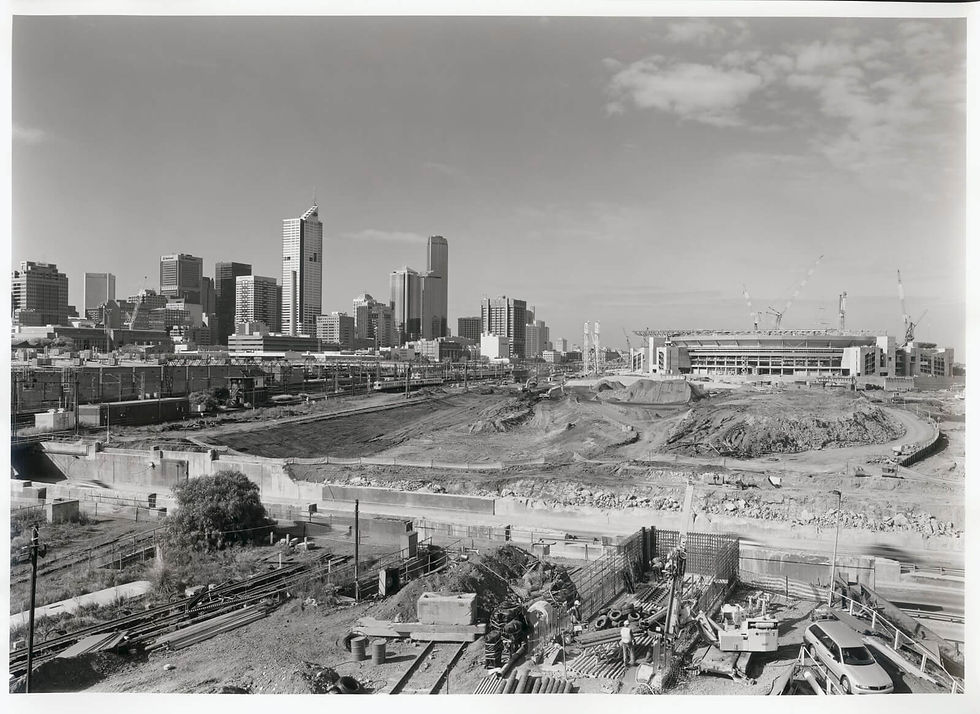
That record is also exactly what a site context analysis would return if it were run on that parcel today: dimensions, frontage, orientation, services, geotechnical conditions, transport access, the planning envelope – a cleared site with excellent fundamentals. But a site context analysis was never built to ask, as I’ve put it elsewhere, ‘what has a place been, what does it still carry, and how should the next layer respond’. The Bog Bar and the Bag Bar survive for us now because Upheaval: Disrupted Lives in Journalism – a book of oral histories charting the transformation of Australian journalism which I contributed to – asked different questions than a site analysis does.
The building is gone, so there’s no fabric left to read. But as I’ve argued elsewhere: ‘the absence of old buildings is not the absence of history. It is the absence of the evidence the industry knows how to look for’.
